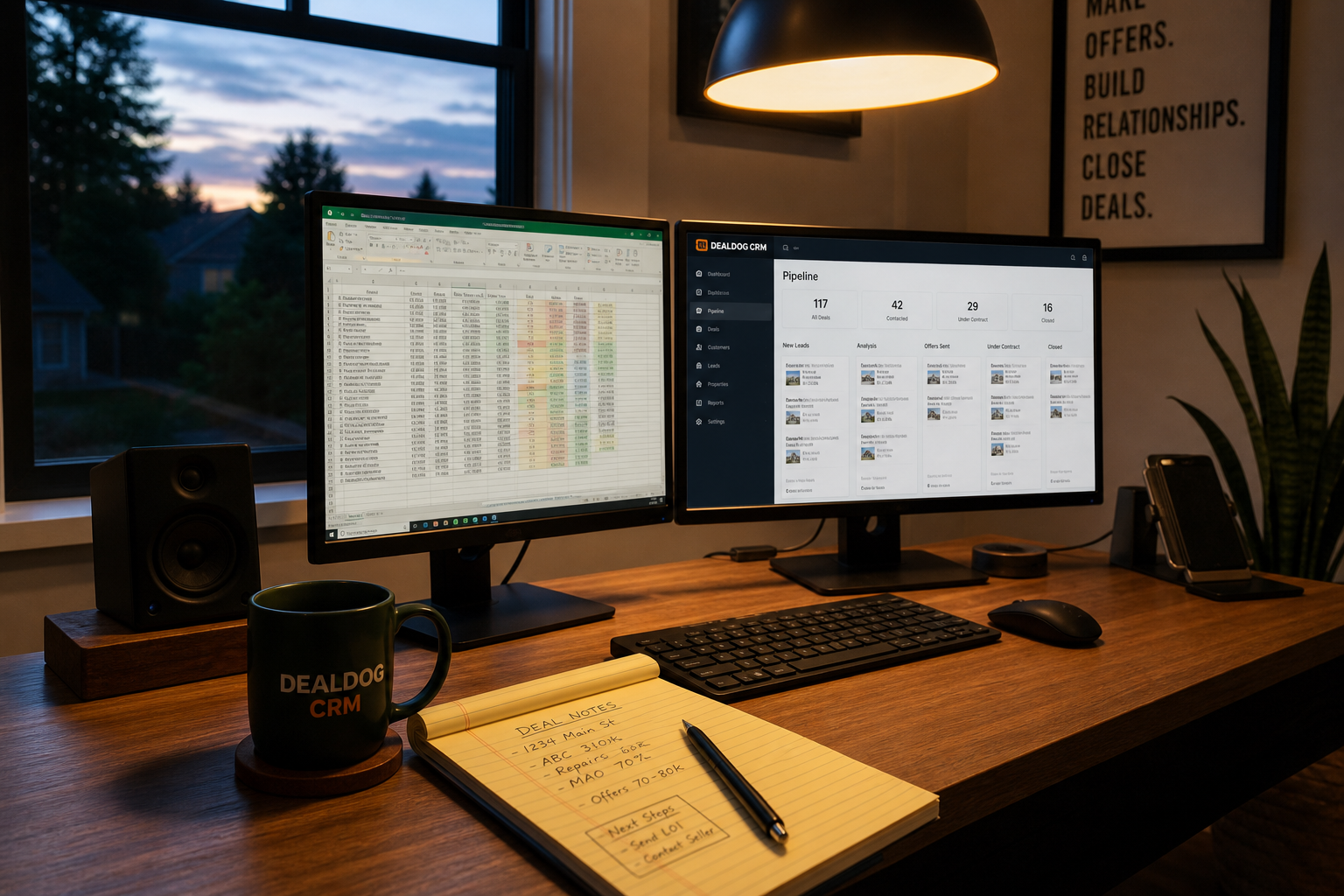
How to Build a Wholesale Business That Runs on AI
When the spreadsheet finally breaks

A wholesaler doing around 20 assignments a year told me something that stuck. She was running three markets, had a buyer list spread across two spreadsheets and a Gmail label she'd named 'DO NOT DELETE,' and her dispositions pipeline was a color-coded tab that only she understood. One afternoon her laptop crashed and she lost six weeks of buyer notes. The deals didn't stop coming. Her ability to match them did.
That's the moment most operators hit somewhere between deal 15 and deal 40. The process that got you here — quick, scrappy, manual — becomes the ceiling. You're not failing at wholesaling. You're failing at the infrastructure under it.
This post is for the operator who's past proof of concept and trying to build something that doesn't collapse when volume picks up, a partner joins, or a bird dog starts submitting deals you didn't have time to underwrite yourself.
Why most wholesalers build in the wrong order
The standard advice is: get a CRM first, then figure out your process. That's backwards. Most off-the-shelf CRMs were built for agents and sales teams — not for operators running assignments, novations, SubTo deals, and BRRRR acquisitions out of the same pipeline. When you pour a wholesale operation into a generic contact database, you end up duct-taping fields, building custom stages, and spending 40 hours configuring something that still doesn't underwrite a deal or match a buyer.
I built DealDog because I kept running into this exact wall. The tools that existed were either too generic to be useful or so bloated that onboarding a new bird dog took a week of training. What I actually needed was something that lived at the intersection of deal analysis, buyer intelligence, and contract generation — not a prettier version of Salesforce.
The contrarian take worth saying out loud: a CRM is the last thing you need, not the first. What you need first is a deal intelligence layer — something that can underwrite an incoming lead in under 60 seconds, match it to a qualified buyer automatically, and generate a letter of intent without you touching a template. Once that's running, you can decide whether a full CRM belongs on top of it.
Per the Federal Reserve's 2024 Report on the Economic Well-Being of U.S. Households, small business operators consistently cite administrative burden as a primary constraint on growth — not deal volume, not capital, not market conditions. For wholesalers, that administrative burden almost always lives in the gap between getting a deal and getting it closed.
What a real deal intelligence layer actually does
When a bird dog submits a deal through your user code on the DealDog Deal Flow Calculator, the first thing that fires is AI underwriting. Not a guess. Not a generic 70% ARV formula someone posted on a forum in 2019. Full analysis: ARV range, repair estimate, MAO, projected assignment fee, cash flow if held, exit strategy fit across wholesale, BRRRR, flip, seller finance, lease option — whatever the asset class calls for. That analysis lands in under 60 seconds.
This matters because the first 30 minutes after a deal comes in are the most important. Sellers who've agreed to a walkthrough go cold fast. Buyers who want first look move on. If your underwriting takes two days because you're waiting to run comps in PropStream and build a spreadsheet, you're already losing deals you don't know you lost.
The second thing that fires is buyer matching. Not against your list — against every buyer registered in the DealDog network. Buy box parameters (geography, price range, asset class, condition preference, exit strategy, funding type) get cross-referenced automatically. If a match exists outside your own buyers, a JV referral structure kicks in. You get compensated for the match. The buyer gets a deal that fits. No cold emails, no posting in Facebook groups, no hoping someone in your network happens to want a C-class fourplex in a secondary market.
The third thing is LOI generation. Branded, auto-generated, sent to the seller. Operators I know have gone from "I'll get you something in writing by end of week" to having a signed LOI in 48 hours. That's not a workflow tweak. That's the difference between a deal that closes and one that dies in a follow-up thread.
The build order that actually scales
Here's how I'd structure this if I were starting a wholesale operation today, or rebuilding one that's outgrown its current stack.
Phase 1 — Deal intelligence before anything else
Start with AI underwriting on every incoming lead. No exceptions. If a deal can't pass a 60-second analysis, you're not losing time walking it through a full CRM pipeline. The filter alone saves hours per week. Use the Deal Flow Calculator with your operator user code so bird dogs and partner wholesalers can submit directly into your account — they don't need their own CRM, they just need your link.
Phase 2 — Buyer infrastructure
Build your buyer database with buy box data, not just names and numbers. A buyer record without asset class preference, condition tolerance, funding type, and geography is just a contact. You can't match against it. Register your buyers in a system that cross-references those fields automatically, and make sure cross-network matching is active so deals that don't fit your list can still close via JV.
Phase 3 — Contract workflow
Get LOI generation into the workflow before a deal hits your pipeline. The LOI is a commitment signal, not a formality. Sellers who've signed an LOI are dramatically less likely to re-trade or ghost. Automating that document removes the friction point that kills more deals than bad numbers do.
Phase 4 — Full CRM (when you actually need it)
If you're running a team, doing branded buyer communications, or managing multiple pipelines across asset classes, then a full CRM subaccount makes sense. That's what DealDog Pro includes — a complete GoHighLevel subaccount with your own domain, branded SMS and email, pipelines, and automations. But that's phase four, not phase one. Most operators running under 30 deals a year don't need it yet.
The artifact — a pre-launch readiness checklist for your deal flow stack
Before you take your first bird dog submission or run your first AI analysis, run through this. Each item has a threshold attached because "mostly done" is the same as not done in a dispositions workflow.
- User code configured — your operator code is live and tested with at least one test submission from an external device (not your own login).
- AI underwriting active on all 15 asset classes — confirm the calculator returns analysis for SFR, multifamily, land, MHP, storage, and commercial, not just residential wholesale. If you only move SFR, confirm the others are at minimum accessible.
- Buyer records include buy box fields — every buyer has geography, price floor/ceiling, asset class, condition preference, and funding type logged. A buyer record missing any of these fields doesn't count.
- Cross-network matching enabled — verify a test deal triggers a match notification, including outside your own buyer list if applicable. Core+ or Pro tier required.
- LOI template reviewed and branded — run one test LOI through the generator and confirm your entity name, contact info, and deal terms render correctly before a live submission.
- Bird dog onboarding tested — have one real or test bird dog submit a deal using your user code and confirm it lands in your account with all fields populated.
- Buyer communication cadence set — decide how fast matched buyers hear from you (under 2 hours is the floor; under 30 minutes wins the deal in competitive markets).
This checklist isn't aspirational. Every item on it represents a specific point where deals have leaked in operations I've watched or run myself.
What happens when the network effect kicks in
DealDog is structured as a network, not just a tool. That distinction matters because the value of buyer matching compounds as more operators, buyers, and bird dogs join. A wholesaler running land deals in the Midwest and a storage operator looking for off-market facilities in the Southeast are both in the same network — and a deal that doesn't fit one operator's buyers might fit another's perfectly, with a referral fee built into the match automatically.
As of Q2 2025, this cross-network JV structure is one of the things that separates DealDog from a standard CRM with a buyers tab. The National Association of Realtors Research & Statistics consistently shows that off-market transaction volume grows when operator networks overlap — the challenge has always been the infrastructure to make those overlaps searchable and compensable. That's the gap this fills.
Operators I've talked to who came from the duct-taped Podio + REISift + spreadsheet stack describe the shift the same way: fewer deals falling through the cracks, faster buyer response, and less time on dispositions chasing the right contact. The tool gets more useful as the network grows. That's the part no single-user CRM can replicate.
If you want to see how the build actually works end-to-end before committing to a tier, the walkthrough is on the homepage. No pitch, no pressure — just the demo and the pricing laid out straight. See how it works at DealDog CRM.
Frequently Asked Questions
What is the right time to start using a CRM for wholesaling?
The right time is when manual tracking is causing you to miss follow-ups or lose buyer matches — not when you hit a specific deal count. Most operators wait too long and lose deals in the gap.
A better sequence: start with AI underwriting and buyer matching infrastructure first, then add a full CRM layer when you have a team or branded communication needs. Paying for a CRM before your deal analysis workflow is solid is like buying shelving before you know what you're storing.
How does AI underwriting work for non-SFR asset classes like mobile home parks or storage?
AI underwriting on DealDog covers 15 asset classes, including MHP, storage, commercial, land, and multifamily. The analysis pulls deal-specific inputs — unit count, occupancy, lot rent or storage rates, cap rate assumptions — and returns ARV range, MAO, exit strategy fit, and risk flags in under 60 seconds.
The output is calibrated per asset class, not a one-size SFR formula applied to a storage facility. That distinction matters when you're trying to set a realistic MAO on a 40-pad MHP versus a single-family flip.
What is cross-network buyer matching and how is it different from a standard buyer list?
Cross-network buyer matching scans every registered buyer in the DealDog network — not just the buyers in your own account — against a deal's parameters. When a match exists outside your list, a JV referral fee structure activates automatically.
A standard buyer list is static and limited to who you've personally collected. Cross-network matching treats the entire operator network as your dispositions resource, which means a deal in a market where your buyer list is thin can still close through a matched JV partner.
What does a DealDog user code do for bird dogs?
A user code lets a bird dog submit deals directly into your DealDog account through the Deal Flow Calculator without needing their own subscription. The submission triggers AI underwriting and buyer matching on your account automatically.
Bird dogs don't see your buyer list or deal pipeline — they just submit and get confirmation the deal landed. You control the deal from that point forward. It's a clean way to run a sourcing network without managing a separate submission inbox or training people on your internal tools.
How much does DealDog cost and is there a free trial?
DealDog has three paid tiers: Core at $49/month, Core+ at $79/month, and Pro at $149/month. All three come with a 14-day free trial — no credit card required to start.
Core includes unlimited AI deal analysis. Core+ adds permanent cross-network buyer matching and unlimited LOI generation. Pro adds a full GoHighLevel CRM subaccount with branded communications and pipeline automations. There's also a no-signup free trial at the Deal Flow Calculator that gives you two AI analyses before you decide on a tier.
Do I need to replace my existing CRM to use DealDog?
No. DealDog is built to bolt onto an existing stack, not force a replacement. If you're running deals through a Podio build, a spreadsheet, or another CRM, you can add DealDog's AI underwriting and buyer matching on top of that without migrating anything.
The Pro tier includes a full CRM subaccount if you want to consolidate, but Core and Core+ are designed specifically for operators who want the deal intelligence layer without touching their current workflow.
