
Deal Flow Calculator vs. Spreadsheet Guessing
The wholesaler who kept leaving money on the table
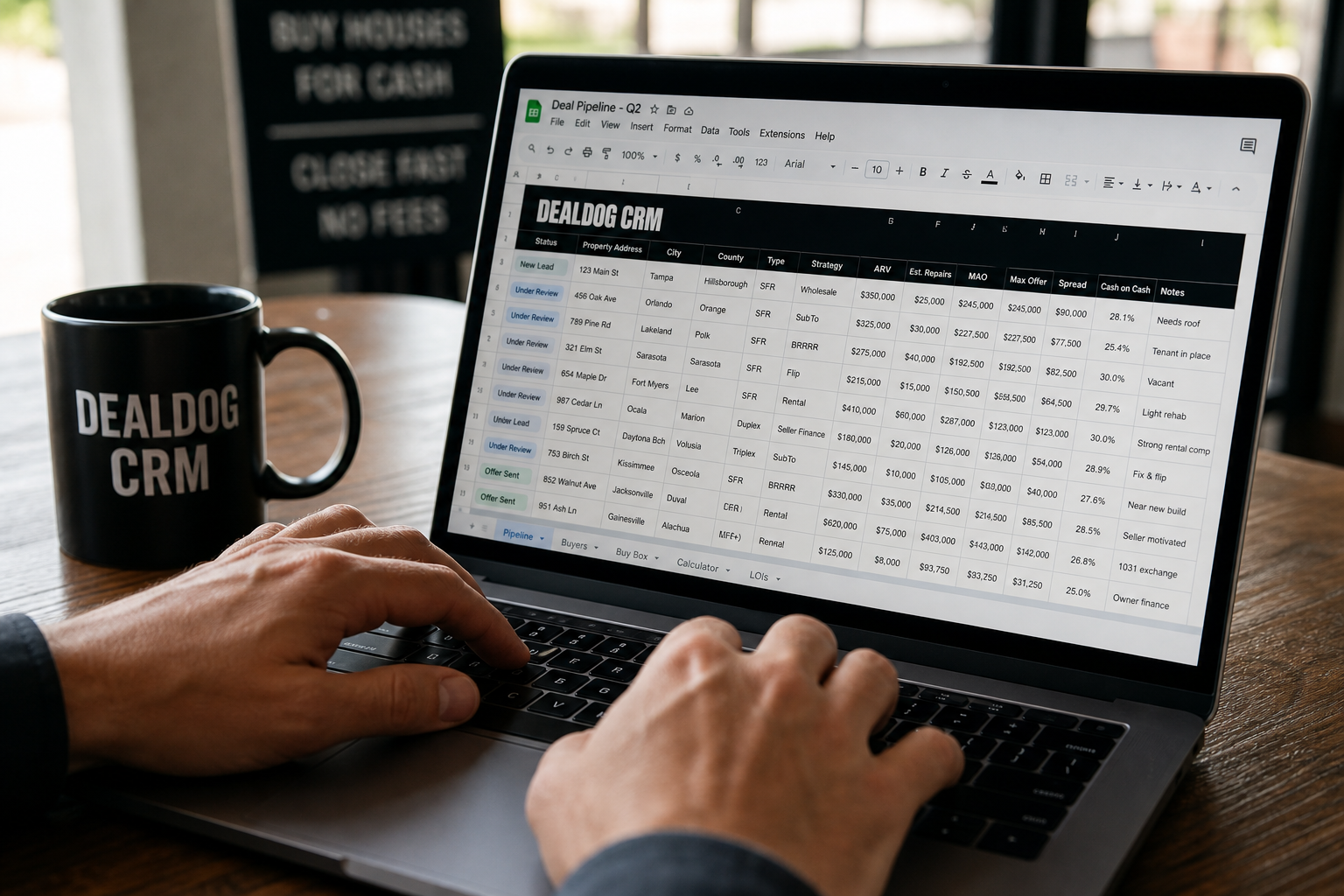
A wholesaler I know in the Midwest was running 30-plus deals a year out of a Google Sheet. Not a bad setup on paper. He had his ARV column, his repair estimate column, his MAO formula. He'd built the whole thing himself over two years.
Every time a new deal came in, he'd open the sheet, copy a row, start plugging in numbers. Somewhere between the comp pull and the repair line items, he'd lose 45 minutes. Sometimes an hour. On a hot deal in a competitive market, that hour is the deal.
The deeper problem wasn't the time. It was that his sheet was built for single-family wholesale. When a mobile home park came across his desk — 18 pads, city water, mix of owned and rented units — he had no framework for it. He passed. Six months later he watched someone else close it at a number he could have hit if he'd had a way to underwrite it fast.
That's the real cost of a static spreadsheet: not just slow math, but the deals you don't even attempt because your tool doesn't speak that asset class.
What a deal flow calculator actually does differently
There's a version of a "deal calculator" that's just a fancier spreadsheet — a web form that outputs the same ARV-minus-repairs-minus-margin math you were doing manually. Those exist, and they're fine if all you do is vanilla SFR wholesale.
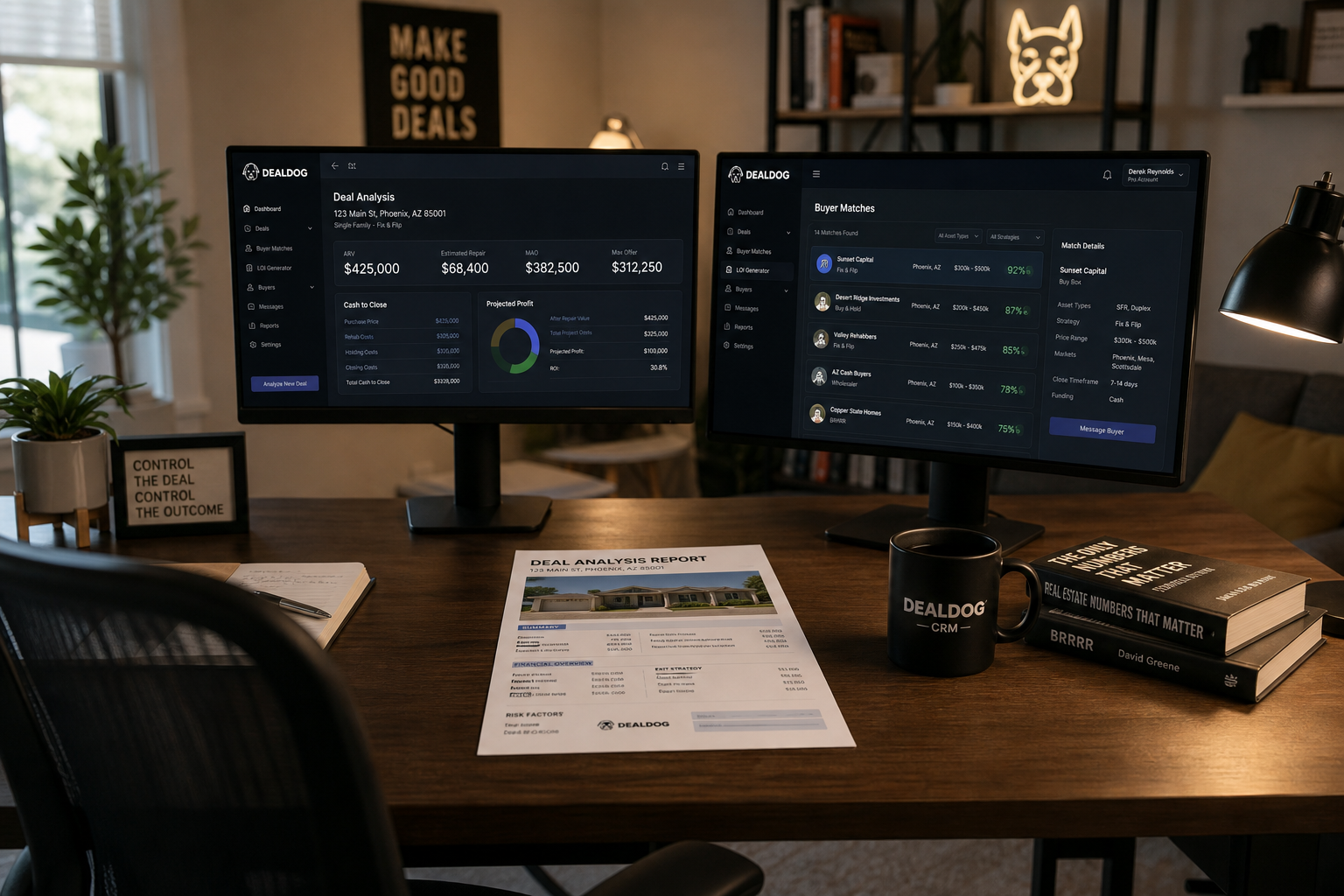
A real deal flow calculator does something different. It reads the deal description, identifies the asset class, selects the right underwriting model, and surfaces the numbers that matter for that specific exit strategy — not a generic formula you have to manually adjust.
The DealDog Deal Flow Calculator runs analysis across 15 asset classes: wholesale, SubTo, BRRRR, flip, rental, multifamily, MHP, STR, commercial, land, novation, lease option, seller carry, Morby method, and JV structures. You paste a deal description or fill the form, and within 60 seconds you've got ARV, repair estimates, MAO, projected cash flow, exit strategy flags, and risk notes.
The difference isn't cosmetic. A SubTo deal has a completely different math profile than a straight wholesale. A mobile home park values on income, not comps. A lease option has optionality baked into the structure. One calculator that treats all of these as the same asset is going to give you garbage numbers on anything that isn't SFR.
Why speed matters more than precision on your first pass
Here's the claim that'll bother some people: on your initial deal evaluation, speed beats precision.
The precision argument goes like this — take your time, pull every comp, get three contractor bids, build the full pro forma before you make an offer. That's solid advice for a deal you're already under contract on. It's the wrong process for your first-pass filter on inbound leads.
Most active wholesalers I know are triaging 20 to 50 leads a week depending on their marketing spend. If you're spending 45 minutes per lead on initial underwriting, you either have to cut your lead volume or burn yourself out doing the math. Neither is a good answer.
A 60-second AI analysis on the front end doesn't replace your deep dive. It tells you whether a deep dive is worth doing. Kill the obvious no's fast. Flag the maybes for a second look. Spend your real time on the deals that clear the initial bar.
Per the Federal Reserve's 2024 Report on the Economic Well-Being of U.S. Households, time constraints are the most commonly cited barrier to scaling among self-employed operators in high-volume transaction businesses. That's not a surprising finding if you're doing 3 dispositions a week and also answering seller calls.
The operators who scale past 50 deals a year almost universally have a fast-triage layer. A deal flow calculator is that layer.
The 8-point deal triage checklist (use this before you write an offer)
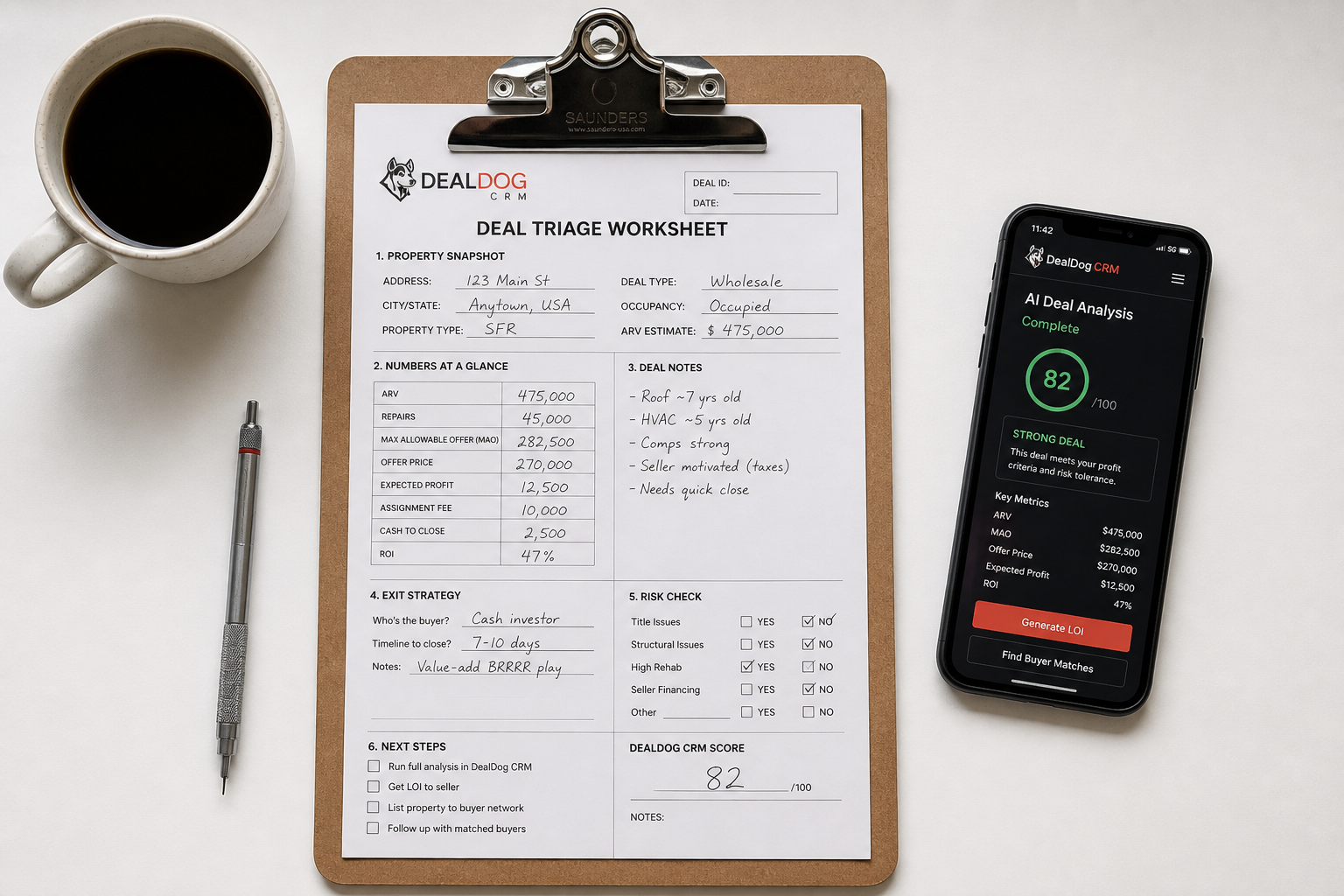
This is the actual sequence I run before committing time to a full underwriting pass. Eight checks, each with a specific threshold. If a deal clears all eight, it earns a deep dive. If it fails two or more, I move on.
- Asset class identified: Know whether you're underwriting on comps (SFR, small multifamily) or income (MHP, storage, commercial). Wrong model = wrong numbers, full stop.
- ARV range established: You need at least 3 closed comps within 1 mile and 90 days. If the market is thin, widen to 6 months before you widen the radius.
- Repair estimate in the right bucket: Cosmetic ($15-$30/sqft), moderate ($30-$55/sqft), or full gut ($55-$90/sqft+). Pick a bucket before you run any MAO math.
- MAO clears your exit: Wholesale MAO is typically ARV x 0.70 minus repairs. SubTo MAO is a different calc entirely — you're buying the payment, not the equity. Know which formula applies.
- Seller motivation confirmed: Timeline, reason for selling, flexibility on terms. A motivated seller is not the same as a seller who just wants top dollar fast.
- Title situation checked: Any liens, probate status, divorce clouds, or IRS encumbrances flagged before you go deep. A title search at this stage is overkill — a quick conversation with the seller covers 80% of it.
- Buyer appetite tested: Do you have at least 2 buyers in your network (or the DealDog network) whose buy box this deal fits? If you can't mentally name them, the deal is real but your disposition plan isn't.
- Exit strategy locked: Wholesale assignment, double close, novation, SubTo hold, BRRRR refi, straight flip. One primary exit, one backup. If you can't name both, you're not ready to make an offer.
Run this checklist in your head while the deal flow calculator is running its analysis. By the time the output lands, you've already pre-screened on the qualitative side. Together, you've got a full first-pass picture in under 10 minutes.
What happens after the calculator — buyer matching and the JV layer

The analysis output is only half the equation. Once you know a deal pencils, the next question is: who's the buyer?
This is where most operators hit the second bottleneck. You've got a solid MHP deal in a secondary market. Your buyers list is 400 names deep, but 380 of them are SFR cash buyers in a different geography. You've got maybe 20 contacts who've ever expressed interest in MHP, and 15 of those haven't responded to an email in six months.
The DealDog network addresses this directly. When you run a deal through the calculator, it doesn't just analyze the numbers — it scans buyer buy boxes across the entire DealDog network, not just your own list. If an operator in another market has a buyer whose criteria match your MHP (location, price range, asset class, exit strategy), you get a cross-network match notification. The JV referral fee structure is built into the workflow, so there's no awkward conversation about splits.
As of Q2 2025, this cross-network matching is the capability that separates DealDog from any standalone calculator or single-user CRM. Your buyer list size stops being the ceiling on your disposition rate.
For operators running creative finance deals — SubTo, seller carry, wraps — the buy box matching matters even more because the buyer pool for those structures is genuinely thin. A cross-network match on a SubTo deal that you couldn't move locally is the difference between an assignment fee and a dead deal.
LOI generation and the days-not-weeks close
One more piece of the workflow that doesn't get enough attention: the Letter of Intent.
Wholesalers and operators lose deals between verbal agreement and signed paper. The seller says yes on a Thursday call. You spend the weekend drafting an LOI, email it Monday, and by Tuesday the seller has taken another call from a competing buyer who showed up with a signed document the same day they agreed verbally.
DealDog's LOI Generator fires automatically after the deal analysis. You're not drafting from a template, adjusting clauses, fixing the address formatting. A branded LOI is ready to send to the seller within minutes of closing the call. That speed signals professionalism, and it keeps the seller's attention on your deal while competing offers are still being typed up somewhere else.
Per the National Association of Realtors Research & Statistics, transaction timelines in off-market residential deals are consistently cited by sellers as a primary factor in accepting an offer over a competing one. Speed of documentation is part of that timeline perception.
The LOI Generator is included free for the first 60 days on the Core tier, and permanently on Core+ and Pro. If you're doing more than 5 deals a month, the time saved on LOI drafting alone covers the subscription cost.
Before your next deal — 3 steps in the next 48 hours
Stop reading and do these three things before the next deal hits your inbox.
- Run one current deal (or pending lead) through the DealDog Deal Flow Calculator at calculator.dealdogcrm.com. No account required for the first two analyses. Compare the output against whatever number you had in your head or your spreadsheet. Note the delta.
- Audit your buyers list against the 8-point triage checklist above. For each buyer, can you name their actual buy box — asset class, geography, price range, exit strategy preference? If more than 30% of your list is fuzzy on any of those four, your buyer matching is broken and you'll feel it on the next disposition.
- Set a triage time limit. Pick a number — 10 minutes, 15 minutes — and commit to it as your first-pass ceiling per lead. Use the calculator to hit that ceiling. Anything that doesn't clear the 8-point checklist in that window goes into a follow-up pile, not a deep-dive queue.
If you want to see the full DealDog workflow — deal submission, AI analysis, buyer matching, cross-network JV, LOI generation — the walkthrough is at dealdogcrm.com. Watch the demo, pick the tier that fits your volume, and run your next deal through it before you run it anywhere else.
Frequently Asked Questions
What is a deal flow calculator and how is it different from a basic MAO calculator?
A deal flow calculator runs full deal underwriting across multiple exit strategies and asset classes, not just a single MAO formula. A basic MAO calculator applies one equation (typically ARV x 0.70 minus repairs) and outputs a single number. A deal flow calculator identifies the asset class, selects the appropriate underwriting model, and surfaces ARV, repair estimates, cash flow projections, risk flags, and exit strategy recommendations in a single pass.
The distinction matters most when you're working anything outside vanilla SFR wholesale. SubTo, MHP, commercial, and land deals each require different math models — a single MAO formula applied to an income-producing asset will give you the wrong number every time.
How do I calculate MAO for a wholesale deal?
MAO for a standard wholesale assignment is calculated as: (ARV x 0.70) minus estimated repairs minus your target assignment fee. If ARV is your anchor, your repair estimate needs to be in the right bucket — cosmetic, moderate, or full gut — before the formula means anything.
For creative finance structures like SubTo or seller carry, MAO is calculated differently because you're pricing the terms, not just the equity. The DealDog Deal Flow Calculator at calculator.dealdogcrm.com handles both standard and creative finance MAO models in the same interface.
Can I use a deal flow calculator for asset classes other than single-family homes?
Yes, and you should. Single-family wholesale is one of 15 asset classes that require distinct underwriting models. Mobile home parks, storage facilities, multifamily, commercial, and land deals all value differently — MHP and storage value on income cap rates, land values on use and entitlement potential, and multifamily on rent rolls and NOI.
A calculator that only handles SFR will produce unreliable numbers on anything else. The DealDog calculator covers all 15 asset classes in a single analysis pass.
How does buyer matching work through a deal flow calculator?
After deal analysis, buyer matching cross-references the deal's profile (asset class, location, price range, condition, exit strategy) against registered buyer buy boxes. In DealDog's case, this match runs across the entire DealDog network, not just the individual operator's buyer list, which means a deal can surface qualified buyers from other operators' networks with JV referral fees built into the match.
The practical result is that your disposition rate is no longer capped by the size of your personal buyers list.
Is a deal flow calculator worth it if I'm only doing a few deals a year?
At low volume, the time savings matter less than the accuracy improvement. Operators doing 5 to 10 deals a year typically have a higher percentage of their capital and reputation riding on each individual deal, which means underwriting errors are proportionally more costly.
The DealDog calculator has a free tier — two full AI analyses with no account and no credit card at calculator.dealdogcrm.com. Run your next deal through it and compare the output against your current process before deciding whether the paid tier makes sense for your volume.
What is cross-network JV matching in real estate wholesaling?
Cross-network JV matching means a deal submitted by one operator gets matched against buyers registered by other operators in the same platform network, not just the submitting operator's own buyer list. When a match fires across operators, a joint venture referral fee is built into the transaction structure so both parties are compensated.
This matters most when your deal is in an asset class or geography where your personal buyers list is thin. A cross-network match surfaces demand you don't have direct access to, which turns otherwise dead deals into closed assignments.
