Free CRM for Real Estate Investors That Actually Works
The tool you're paying for is probably doing less than you think

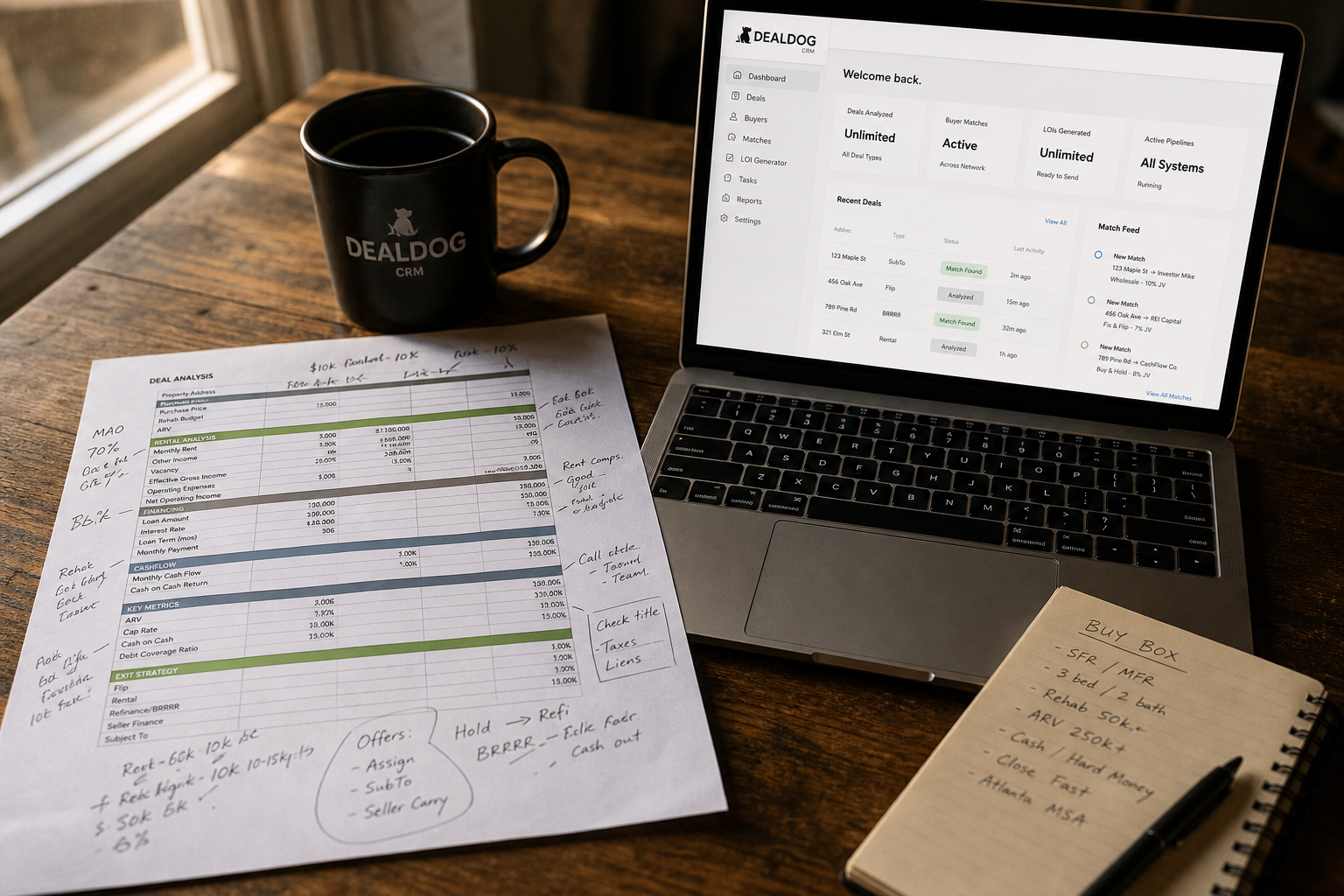
Most wholesalers and flippers I talk to are running some version of the same setup: a spreadsheet for their buyers list, a separate calculator for underwriting, maybe a Podio build that took three weeks to configure and still doesn't pull comps the way they need, and a folder of signed LOIs that got drafted manually each time.
That stack costs real money every month. And the output — slow underwriting, stale buyer data, deals that die on dispositions — isn't proportional to what's being paid for it.
The argument for a free real estate investor CRM isn't that free tools are always good. It's that most paid tools in this space are charging operator-tier prices for entry-level functionality. If you're doing 10 to 30 deals a year across SFR, multifamily, land, or mobile home parks, you shouldn't need a $300/month stack to manage deal flow and close assignments.
DealDog's Core plan is free. Not a trial, not a freemium bait-and-switch with a hard paywall on anything useful. Free, with unlimited AI deal analysis across 15 asset classes, in-network buyer matching, and LOI generation built in. The reasoning is simple: operators who can actually use the tool every day are the ones who grow into the paid tiers when their volume demands it. That's the honest version of the model.
What free actually includes (and what it doesn't)
Core is free forever. Here's what ships with it.
The AI deal underwriting covers all 15 deal types DealDog supports: wholesale assignments, SubTo, BRRRR, fix-and-flip, rental holds, multifamily, land, mobile home parks, short-term rentals, commercial, novation, lease options, seller carry, Morby method structures, and mixed-use. You paste a deal description or fill the submission form at calculator.dealdogcrm.com and get a full analysis in roughly 60 seconds — ARV, repair estimate ranges, MAO, cash flow projections, exit strategy scoring, and risk flags.
That's not a teaser. That's the full underwriting engine, no cap on deal volume.
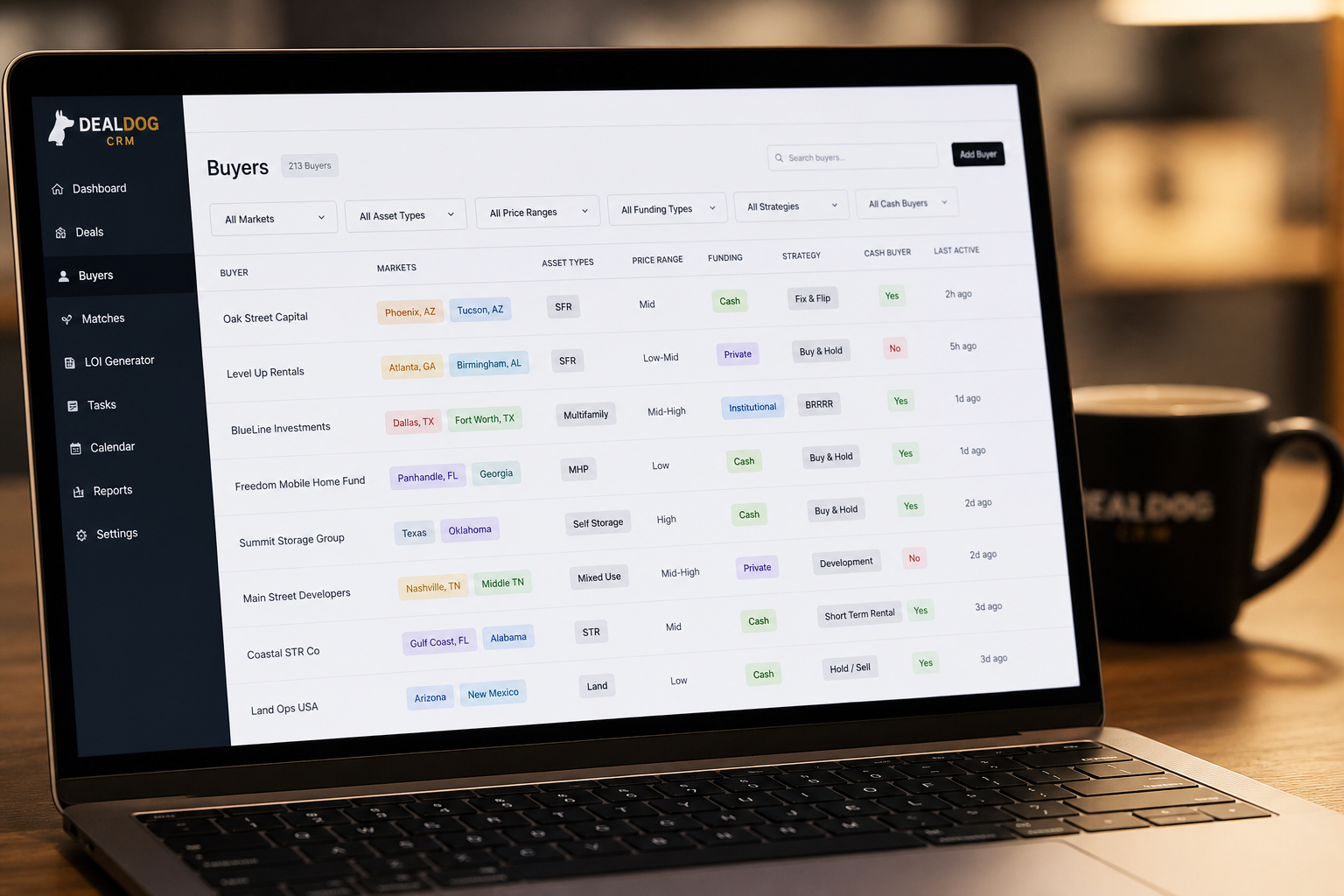
Buyer list management is also included. You can build your buyer database inside Core, tag buyers by buy box (geography, price range, asset type, exit strategy, funding type), and run in-network matches when you load a deal. The system scans your registered buyers automatically and surfaces qualified matches based on their criteria, not just location.
LOI generation is in there too. When a deal clears your underwriting threshold, Core generates a branded Letter of Intent as a PDF and can send it directly to the seller. For operators who have historically spent an hour drafting and chasing signatures on each LOI, this alone changes the pace of how deals move.
What Core doesn't include is cross-network matching — that's where DealDog scans the entire platform's buyer pool, not just your own list. That's a Core+ feature at $79/month. If your buyers list is thin or regionally limited, that's the unlock. But for operators with an established buyer base, Core handles the workflow without a monthly fee.
Why most 'free' investor tools fail in the first 30 days

The pattern is predictable. A free tool launches with a stripped-down feature set designed to frustrate the user into upgrading. The calculator doesn't save deals. The buyer database has a 10-contact cap. The export function is locked. You get enough to see the product, not enough to use it.
That model works for SaaS companies that are selling to people who don't know what they need yet. It doesn't work for active investors who are running deals and need the tool to do real work from day one.
The other failure mode is complexity. Some platforms offer a genuinely capable free tier, but the setup takes a week of configuration, YouTube tutorials, and a GoHighLevel snapshot import to get running. Operators building a wholesale operation don't have a week. They have a motivated seller calling back in 48 hours.
DealDog's Core is designed to be useful on the first session. You sign up, connect your user code, and the deal submission form is live. Bird dogs can start submitting deals through your link the same day. Buyers can register their buy box and start receiving match notifications without a manual setup on your end.
The contrarian take here is worth stating plainly: a CRM you configure for a week and then abandon because it doesn't match your actual workflow is worth less than a simpler tool you actually open every time a deal lands. Operators I know who run consistent volume tend to use the simplest system that does the job — not the most feature-rich one they can justify on a cost-per-deal basis.
Per the 2024 Fed Small Business Credit Survey, a significant share of small business operators cite administrative overhead as a top constraint on growth — not capital access alone. For real estate operators, that administrative drag is almost always deal tracking and buyer communication. A tool that reduces both without adding a new monthly line item has a direct effect on margin.
The buyer list problem most operators don't solve until it's too late
Ramona, a land wholesaler in the Midwest running roughly 20 deals a year, described her buyer list to me this way: "I have 400 contacts in a spreadsheet. Maybe 60 of them have bought something in the last two years. I don't know which 60."
That's not a small problem. That's the core of why deals stall in dispositions. You underwrite a parcel, get it under contract, then spend three days blasting an email list that's 85% unresponsive while your seller's patience runs thin.
A buyer database that's organized by buy box — not just name and email — changes how fast dispositions move. When a deal hits the system, the match runs against actual buyer criteria: geography, price band, asset type, whether they're buying cash or using hard money, what condition they'll accept. The buyers who get notified are the ones who asked to be notified for deals that look exactly like this one.
That's what Core's in-network buyer matching does. And it's free.
The next layer — cross-network matching through the full DealDog buyer pool — becomes relevant when your own list doesn't have a qualified buyer for a specific asset type or geography. A 12-unit multifamily in a tertiary market, a 40-acre raw land parcel in a state you don't usually work, a mobile home park with existing tenant issues. Those deals need a buyer network that extends past your direct contacts. That's Core+. But the foundation — a clean, buy-box-tagged buyer database with automatic match logic — is in Core at no cost.
For context on how buyer-matching technology is evolving across the proptech space, NAR's research division has tracked the acceleration of data-driven transaction tools since 2022, and the pattern is consistent: operators who systematize buyer relationships close faster and with fewer dead-end negotiations.
The artifact: Core setup checklist before your next deal hits
If you're starting on Core today, here's the sequence that gets the workflow live before the next deal needs to move. Run this in one session.
- Create your account and generate your user code at calculator.dealdogcrm.com/signup — this is the link you'll give bird dogs and wholesalers to submit deals directly into your pipeline.
- Load your existing buyers into the buyer database with at least four fields per contact: geography (county or metro), price range, asset type, and funding source (cash, hard money, conventional). Incomplete profiles won't match correctly.
- Run your last 3 deals through the AI underwriter — not to re-decide them, but to calibrate your eye against what the system surfaces. If the ARV or MAO ranges don't match your market knowledge, adjust your input detail (comp radius, property condition, rehab scope).
- Set up your first buyer buy box for your highest-volume buyer type. The system needs at least one registered buy box to run a match on a new deal. Don't skip this step.
- Send your user code link to 2-3 bird dogs or wholesalers in your network this week. Even one inbound deal submission through the system will show you how the pipeline populates.
- Generate a test LOI on a deal you've already closed. Confirm the formatting matches what you'd send a seller. Adjust the branding fields if needed before you're under contract on something live.
Six steps. One session. The workflow is live before your next deal needs it.
Where Core ends and the paid tiers start
There's no trick here. Core is genuinely free, and it covers a real portion of the workflow for operators running under 30 deals a year with an established buyers list.
The two places where Core hits a ceiling are cross-network buyer matching and automation depth.
Cross-network matching (Core+ at $79/month) matters most when you're working asset classes or geographies where your own buyers list is thin. It also matters for operators who want to participate in JV deals — when a DealDog user in another market has a deal that matches your buyer's criteria, the cross-network match fires and a referral fee structure is built into the workflow. That's not a feature you'd build yourself in a spreadsheet.
The Pro tier at $149/month adds a full GoHighLevel CRM subaccount, branded buyer communications from your own domain, pipeline automation, and SaaS-mode operations for teams running higher volume. If you're scaling past 50 deals a year or managing a small team, the Pro infrastructure replaces the duct-taped Podio + REISift + spreadsheet stack that most operators are running by that point.
As of Q2 2025, all paid tiers include a 14-day free trial. No credit card required to start on Core. The progression from Core to Core+ to Pro is designed to match where operators actually are in their deal volume — not to push everyone into the highest tier on day one.
If you want to see how the full platform handles a deal from submission to signed LOI, the walkthrough is at dealdogcrm.com. The demo covers all five core capabilities and shows the buyer matching logic running on a live deal type.
Frequently Asked Questions
Is there really a free forever CRM for real estate investors?
Yes. DealDog's Core plan is free with no time limit and no credit card required. It includes unlimited AI deal analysis across 15 asset types, in-network buyer matching, buyer list management, and LOI generation.
The paid tiers (Core+ at $79/month and Pro at $149/month) add cross-network buyer matching across the full DealDog platform and, at Pro, a full GoHighLevel CRM subaccount with pipeline automation.
What does free real estate investor CRM software actually include?
On DealDog Core, you get the deal flow calculator at calculator.dealdogcrm.com, full AI underwriting on any deal type (wholesale, SubTo, BRRRR, land, multifamily, MHP, commercial, and more), a buyer database with buy box tagging, automatic in-network buyer matching, and LOI generation as a PDF sent directly to the seller.
What's not included on Core is cross-network JV matching against the broader DealDog buyer pool and advanced automation. Those are Core+ and Pro features.
How does AI deal underwriting work for wholesalers?
You submit a deal description through the calculator form — property type, location, condition notes, asking price, and any known repair scope. The AI returns an ARV range, estimated repair costs, MAO, cash flow projections for rental or BRRRR exits, exit strategy scoring, and risk flags, typically within 60 seconds.
The analysis draws on the deal parameters you provide, so more specific inputs (comp radius, condition grade, rehab line items) produce tighter ranges. Operators who run several deals through it early tend to calibrate their inputs against their own market knowledge after the first two or three analyses.
What is buyer matching in a real estate CRM?
Buyer matching is the automated process of comparing a deal's characteristics against registered buyer criteria (buy box) to surface qualified buyers without manual filtering. In DealDog, when a deal is loaded, the system scans every buyer in your database whose buy box overlaps with that deal's geography, price range, asset type, and exit strategy.
Cross-network matching, available on Core+ and Pro, extends that scan to every buyer registered across the entire DealDog platform, not just your own list. Match notifications fire automatically, and JV referral fee structures are built into the workflow.
How is DealDog different from Podio or a spreadsheet for managing deals?
Podio requires significant configuration to function as a deal management system, and most wholesale-specific setups involve third-party integrations (REI Automations, Zapier, custom pipelines) that add cost and maintenance overhead. A spreadsheet has no matching logic, no automated LOI generation, and no underwriting.
DealDog ships with underwriting, buyer matching, and LOI generation built into a single workflow. The Core plan is free. Operators can bolt it onto an existing stack or, at Pro tier, replace the stack entirely with a GoHighLevel-powered CRM subaccount.
Can bird dogs and wholesalers submit deals to my DealDog account?
Yes. Every DealDog account generates a unique user code that produces a shareable deal submission link. Bird dogs, wholesalers, and JV partners can submit deals directly into your pipeline through that link without needing their own account setup.
Buyers can also register their buy box through your user code link, which means they're added to your buyer database with their criteria already populated for matching.
