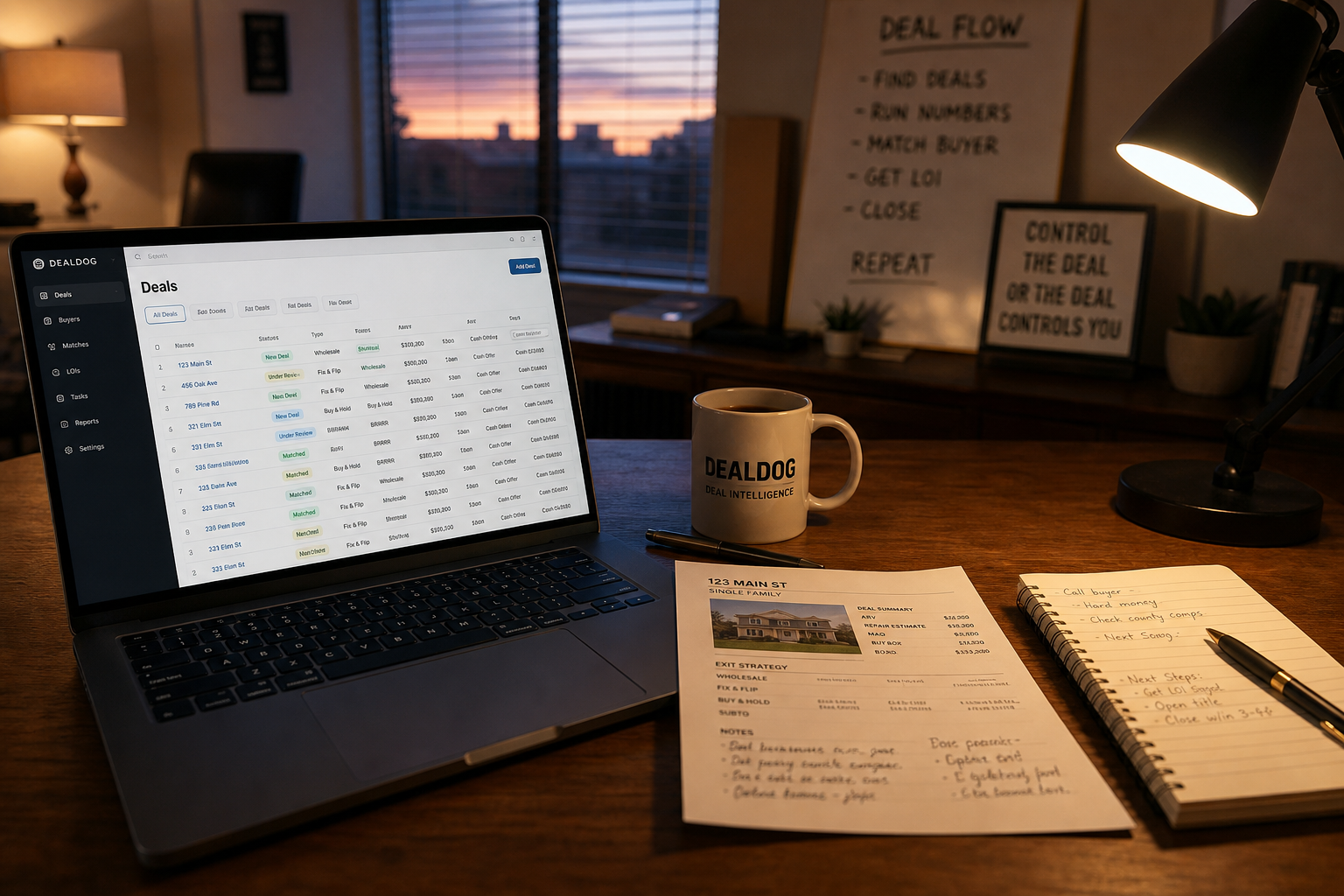
Free Deal Analysis That Actually Closes Deals
The deal that almost died on a spreadsheet

Marcus, a wholesaler working the Kansas City market, had a mixed-use property under contract. Two-unit commercial bottom, two residential apartments above it. He'd run his numbers on a spreadsheet he'd been using since 2021, felt decent about the spread, and started calling buyers.
Three passed. Two ghosted. One came back with a counter that made no sense given the asset class. Marcus didn't lose that deal because the numbers were wrong. He lost it because his buyer list was built around SFR flippers, and nobody in his personal network bought mixed-use.
That's the gap most operators don't see until they're already holding a contract they can't move. The underwriting problem and the buyer-matching problem look like separate issues. They're not. They're the same workflow failure showing up at two different points in the same deal.
What changes when you solve both at once — with a free system — is the subject of this post.
Why most operators underwrite the wrong asset class
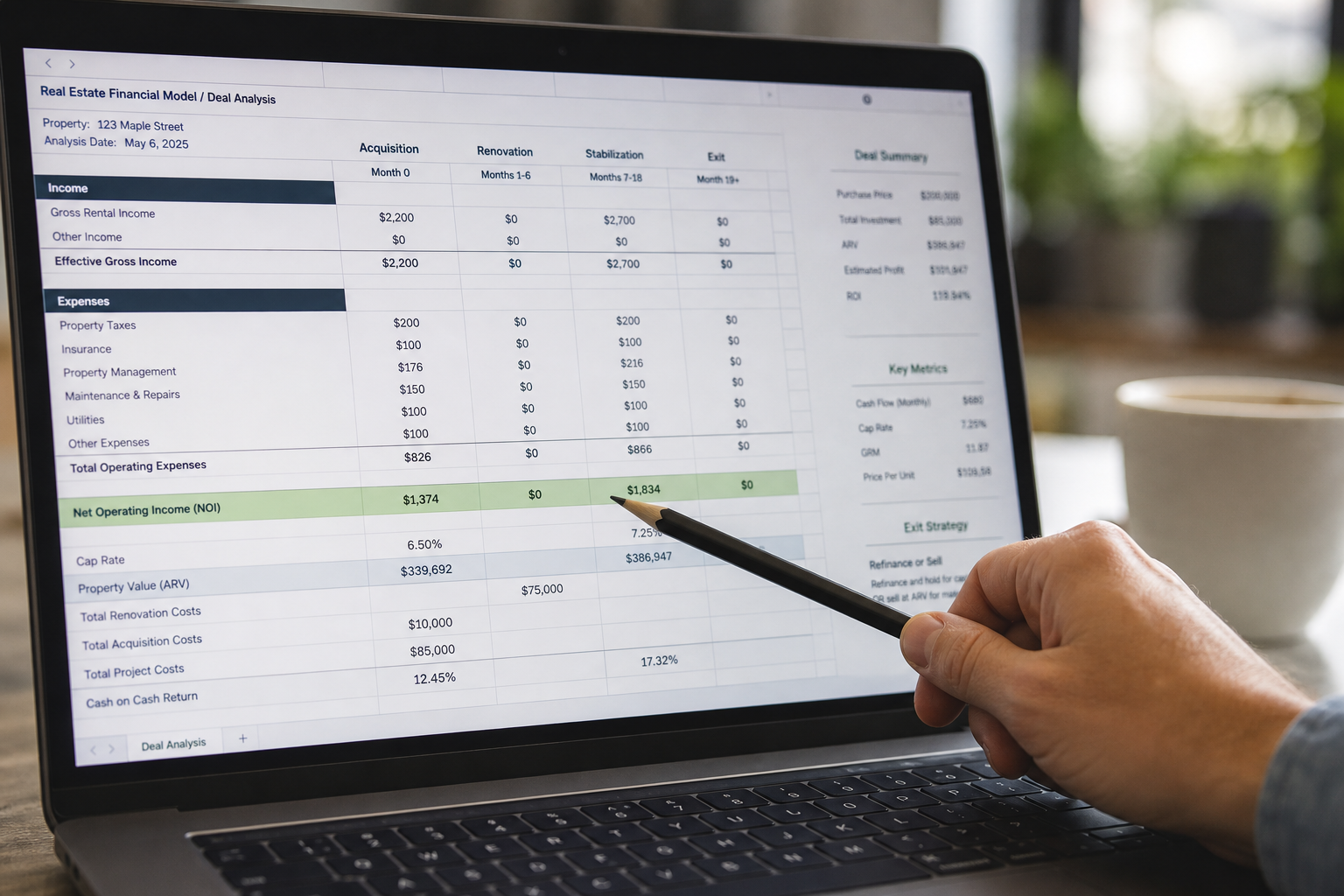
The default in this industry is SFR math. ARV minus repairs minus your margin gets you to MAO. That framework works fine on a three-bedroom ranch in a suburb where comps are everywhere. It breaks down fast on a mobile home park, a self-storage facility, a commercial strip, or a seller-finance deal where the exit is a wrap, not a flip.
Per National Association of Realtors 2024 Commercial Real Estate Outlook, commercial and mixed-use transaction volume remains active even in rate-compression environments, yet most wholesaler tools still don't account for cap rate, NOI, or DSCR in their deal calculators. That's not a feature gap — it's a structural one. The tools were built for one asset class and never extended.
What this means practically: a BRRRR operator analyzing a small multifamily is doing cash-on-cash math in a spreadsheet while also guessing at rent rolls. A land wholesaler is running acreage comparables by hand. A SubTo operator is modeling seller carry terms in a separate Google Sheet because no single tool covers all of it.
Across 15 asset classes — SFR, multifamily, commercial, land, MHP, STR, storage, mixed-use, BRRRR, novation, SubTo, seller finance, wrap, lease option, and JV structures — the underwriting requirements are different enough that a one-size calculator will misprice deals. And mispriced deals either don't get offered, or they get offered at the wrong number and fall apart at due diligence.
The fix isn't a smarter spreadsheet. It's an underwriting layer that knows which model to run based on the deal type you select — before you ever call a buyer.
What a buyer buy box actually does when it's wired to your deal flow
Most wholesalers keep their buyer list in a spreadsheet or a contact group in their phone. They know roughly what each buyer wants because they've talked to them. When a new deal comes in, they scroll through names and start dialing. That workflow works at low volume. It doesn't scale, and it fails completely when the deal type doesn't match the buyers you happen to know personally.
A buyer buy box is a structured profile: geography, asset class, price range, condition tolerance, funding type (cash, hard money, DSCR, seller finance), preferred exit strategy. When that profile is attached to an automated matching layer, every deal you run gets scanned against every registered buyer the moment the underwriting clears.
According to NAR's 2024 Home Buyers and Sellers Generational Trends report, speed of transaction remains one of the top factors buyers cite in deal satisfaction — meaning the operator who surfaces the right deal to the right buyer first wins the disposition, not the one with the longest list.
The practical difference: instead of running 40 outbound calls to figure out who might be interested in a six-unit multifamily in Memphis, you have a matched shortlist before you pick up the phone. The calls you do make are to buyers who already said they want exactly that asset type, in that geography, at that price point.
For operators working creative finance deals — SubTo, wraps, seller carry — the buy box matching matters even more. The buyer universe for a SubTo deal is smaller and more specific than for a straight assignment. Getting the wrong buyer on the phone wastes everyone's time and makes you look disorganized. Getting the right buyer on the phone in the first conversation is how you move from weeks to days on disposition.
The contrarian case for starting with a free tool instead of a paid CRM stack
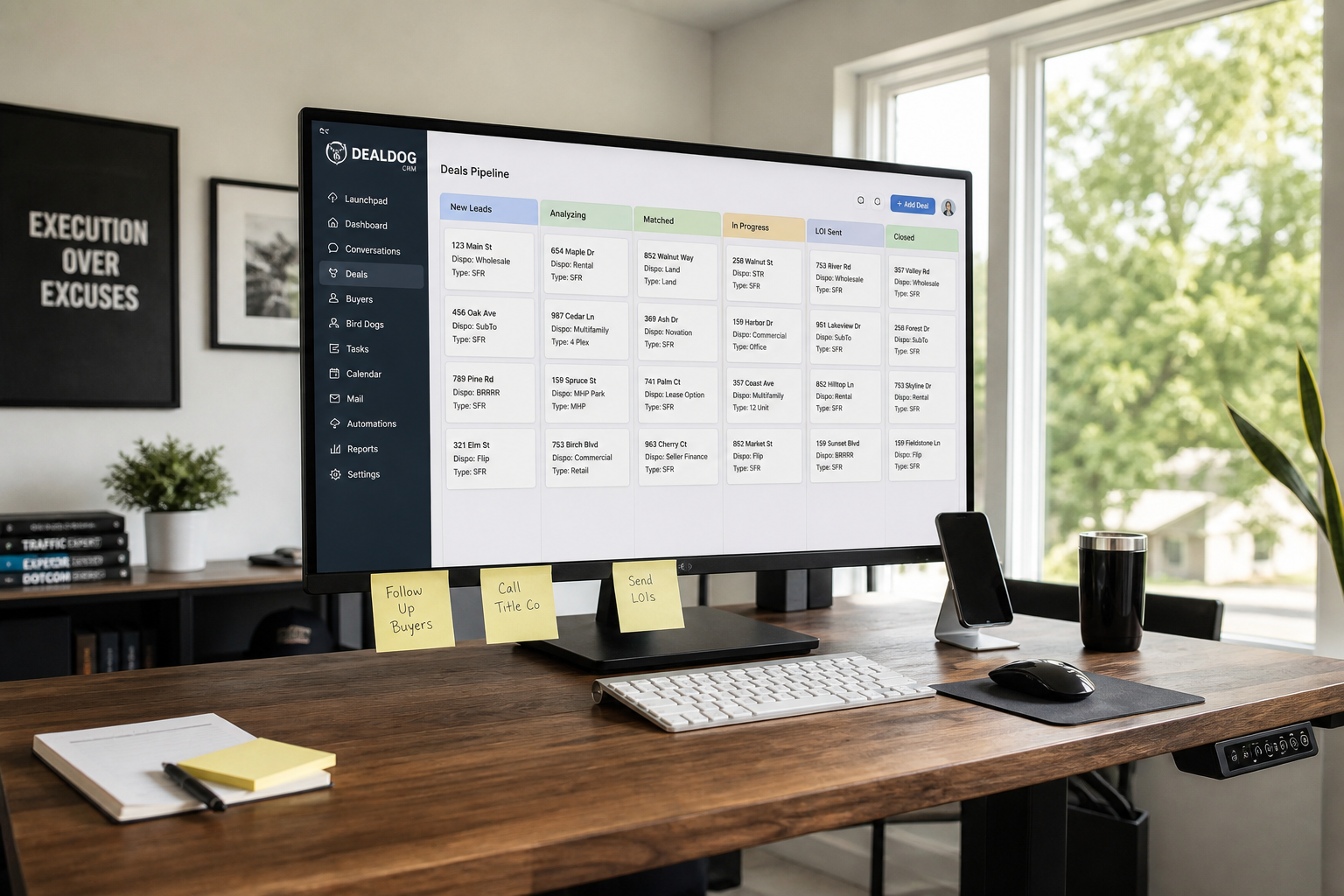
The standard advice in this industry is to build your CRM first. Get your pipeline organized, get your automations running, then worry about underwriting. That advice is backwards, and it's expensive.
Here's the actual sequence of events for most new operators: they buy a $200/month CRM, spend three weeks setting up pipelines they barely understand, and then realize the tool doesn't actually help them figure out if a deal is worth pursuing or who to sell it to. The CRM organized their confusion. It didn't fix it.
Deal intelligence comes before deal management. If you can't underwrite the deal in the asset class it's actually in, and you can't match it to a buyer with a confirmed buy box, the pipeline is irrelevant. You're organizing leads you can't close.
Starting with a free underwriting and buyer-matching system — one that runs AI analysis across all 15 asset classes and matches against a live buyer network — means you validate your deal flow before you invest in the infrastructure to manage it. You find out fast whether your market, your deal type, and your buyer access are actually aligned. That discovery is worth more than any pipeline automation.
DealDog's Core tier is free, permanently. Unlimited AI deal analysis across all 15 deal types, in-network buyer matching, and LOI generation — no monthly fee. For operators who are just getting their systems figured out, or experienced investors who want a clean second layer over an existing stack, free is the right starting point. The paid tiers exist for when volume and cross-network matching become the constraint, not before.
If you want to see what the dashboard actually does, the Deal Flow Calculator is live and free — no credit card, no signup wall to try it.
What the dashboard actually controls and why it matters for volume operators
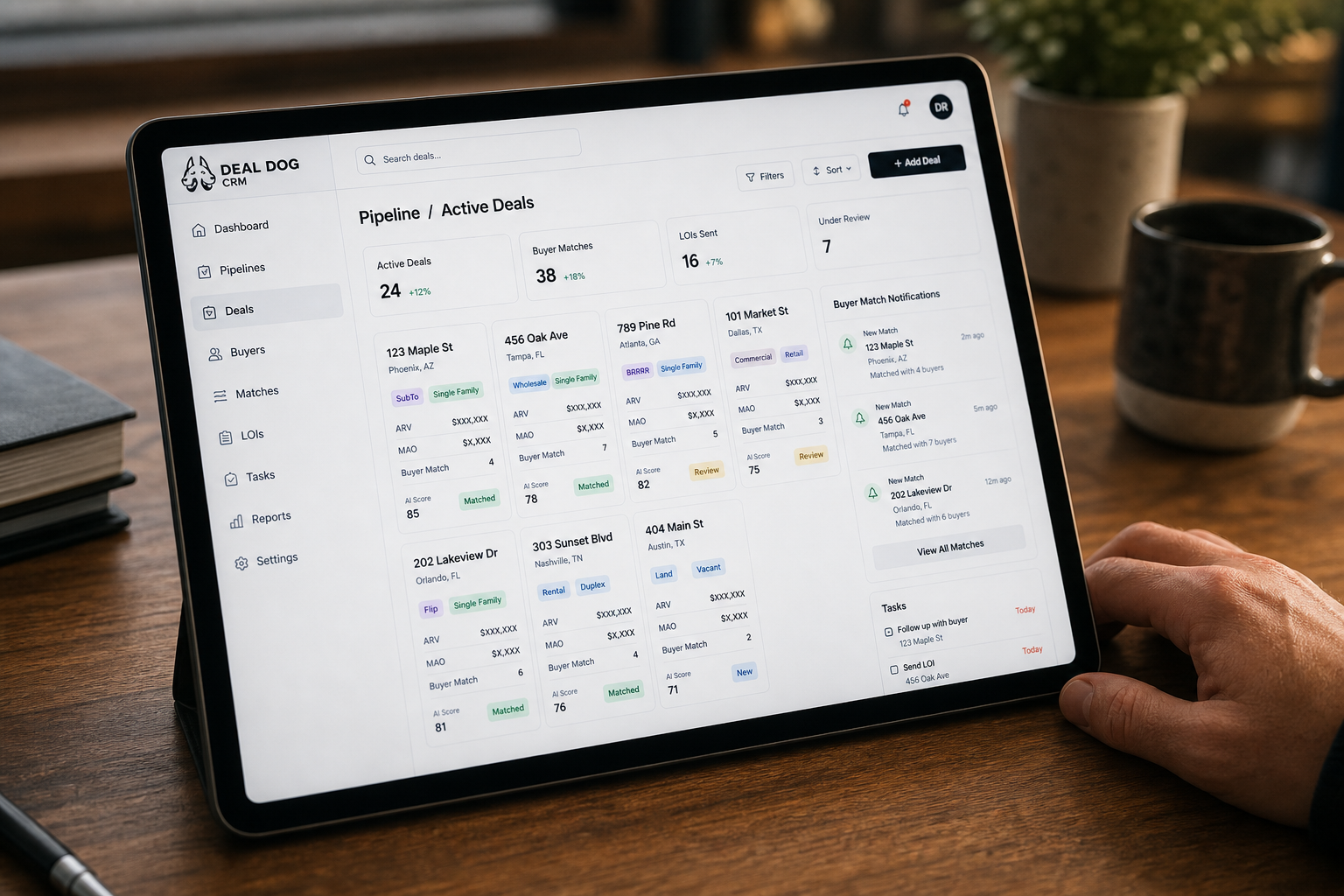
A deal dashboard isn't a vanity feature. For operators running more than a handful of deals at a time, the dashboard is the difference between knowing where every deal stands and losing track of follow-up on a contract that's two days from expiring.
The DealDog dashboard gives operators a single view across every deal in their pipeline: underwriting status, buyer match results, LOI generation, and inbound submissions from bird dogs and wholesalers using your unique user code. That last piece is worth pausing on. Bird dogs can submit deals directly into your account using your code. Wholesalers in your network can submit deals or run the calculator under your umbrella. Buyers register their buy box and get matched automatically. The operator doesn't have to manually intake any of it.
For a volume fix-and-flipper running deals in multiple markets, or a commercial operator with JV partners submitting properties, the ability to have every inbound deal automatically underwritten and matched before it hits your review queue changes what's possible in a given week. You're not spending Monday morning running numbers on five different spreadsheets. You're reviewing AI-generated analysis on five deals that already know which buyers fit.
Raquel, a BRRRR investor working the Dallas-Fort Worth market, had been running her analysis on a combination of a rental property calculator she'd found online and a spreadsheet for tracking repair estimates. When volume hit a point where she was reviewing multiple deals a week across both SFR and small multifamily, the manual process became the bottleneck. She moved her underwriting into DealDog's Core tier, ran the AI analysis on her next four deals, and cut her review time down significantly — her words in a support conversation were that she was spending time on the deal decisions, not the deal math.
That's the actual value of a dashboard: it removes the administrative overhead so the operator can do operator work.
Before your next deal goes under contract: a 48-hour readiness check
If you're running deals right now and haven't standardized your underwriting and buyer-matching workflow, here's what to do before the next contract hits your desk.
- Run your last deal through the AI calculator at calculator.dealdogcrm.com — select the correct asset class (not just SFR by default), paste the deal description or fill the form, and compare the output to what you ran manually. The gaps tell you where your current process is underpricing or overpricing.
- Audit your buyer list for asset class coverage. Pull up your buyer contacts and tag each one by the deal types they've actually closed with you or confirmed they buy. If your list is 90% SFR flippers and you're working a market with multifamily or commercial inventory, you have a coverage problem. Fix it by registering buyers in DealDog with their actual buy box, not just their phone number.
- Set up your operator user code and share it with at least two bird dogs or wholesalers in your network. Every submission they make flows into your dashboard pre-underwritten. You're not doing intake — you're doing decisions. Even at zero monthly cost on the Core tier, this changes how many deals you can review in a week without adding headcount.
For operators ready to move past the free tier and run cross-network buyer matching — matching your deals against every buyer in the full DealDog network, not just your own list — the Core+ tier at $79/month includes that plus unlimited LOI generation. If you want to see how the full system is set up before committing to anything, dealdogcrm.com has a walkthrough demo at your own pace.
Frequently Asked Questions
What is a buyer buy box in real estate wholesaling?
A buyer buy box is a structured profile of exactly what a buyer will purchase: asset class, geography, price range, condition tolerance, funding type, and preferred exit strategy. It's the criteria a buyer uses to say yes or no to a deal before they ever see the numbers.
When buy box profiles are stored in a matching system like DealDog, every new deal gets scanned against every registered buyer automatically. The operator gets a matched shortlist instead of running manual outreach across a full contact list.
How does AI deal underwriting work for real estate investors?
AI deal underwriting takes the property details you input — address, asking price, condition, deal type — and runs them through asset-class-specific financial models to produce ARV estimates, repair ranges, MAO, cash flow projections, and risk flags in about 60 seconds.
DealDog's AI underwriting covers 15 deal types including SFR, multifamily, SubTo, BRRRR, land, MHP, and commercial, so the model it applies matches the actual deal structure rather than defaulting to a generic ARV-minus-repairs formula that misfires on non-SFR assets.
Can a new real estate investor use DealDog for free?
Yes. DealDog's Core tier is free permanently and includes unlimited AI deal analysis across all 15 asset classes, in-network buyer matching, and LOI generation. No credit card is required to start.
The free tier is a reasonable permanent setup for operators at lower volume. The paid tiers (Core+ at $79/month, Pro at $149/month) add cross-network buyer matching across the full DealDog network and, at the Pro level, a full GHL CRM subaccount with branded communications and pipeline automation.
What is cross-network buyer matching and how is it different from a buyer list?
Cross-network buyer matching scans your deal against every registered buyer across the entire DealDog platform, not just the buyers in your personal account. When your own list doesn't have a buyer for a specific asset class or market, the network match surfaces buyers from other operators' accounts and routes the deal with a JV referral fee built into the workflow.
A buyer list is static. Cross-network matching is a live scan against a growing pool of registered buyers with confirmed buy boxes, which means deals that would have died on a thin personal list get a second shot through the broader network.
How do bird dogs submit deals to a wholesaler's DealDog account?
Each DealDog operator gets a unique user code. Bird dogs use that code to submit deals directly through the Deal Flow Calculator at calculator.dealdogcrm.com. The submission flows into the operator's dashboard pre-underwritten, with AI analysis already attached.
The bird dog doesn't need their own paid account. The operator controls the intake, the underwriting runs automatically, and the operator reviews deal decisions rather than doing manual data entry on every submission.
Does DealDog work for asset classes beyond single-family residential?
Yes. DealDog's AI underwriting covers 15 deal types: SFR, multifamily, commercial, land, mobile home parks, short-term rentals, self-storage, mixed-use, BRRRR, novation, SubTo, seller finance, wraps, lease options, and JV structures. The financial model applied to each deal is specific to the asset class selected, not a generic ARV formula applied uniformly.
This matters most for operators working commercial or creative finance deals, where standard SFR math either misfires on the numbers or doesn't model the deal structure at all.
