
Free Real Estate CRM That Actually Underwrites Deals
Most new investors spend money before they make any

A wholesaler just getting started in, say, Memphis or Columbus runs into the same wall pretty fast. Somebody on a Facebook group tells them they need a CRM. Then a skip-tracing tool. Then a deal calculator. Then a buyer list. By the time they've duct-taped those four things together, they're paying $300–$500 a month and haven't closed a single deal.
That's not a workflow. That's a tuition payment to the software industry.
Most of those tools weren't built by people who actually wholesale or flip. They were built by SaaS founders who saw a gap in the market and filled it with a pretty dashboard. The result is bloated, confusing, and way too expensive for someone still trying to figure out their first MAO calculation.
DealDog Core exists because I got tired of watching operators — especially newer ones — sink money into tools before they had the reps to know what they actually needed. So we made the core of what DealDog does permanently free. Not a trial. Not a freemium trap. Free forever.
What free actually means here — and what it covers
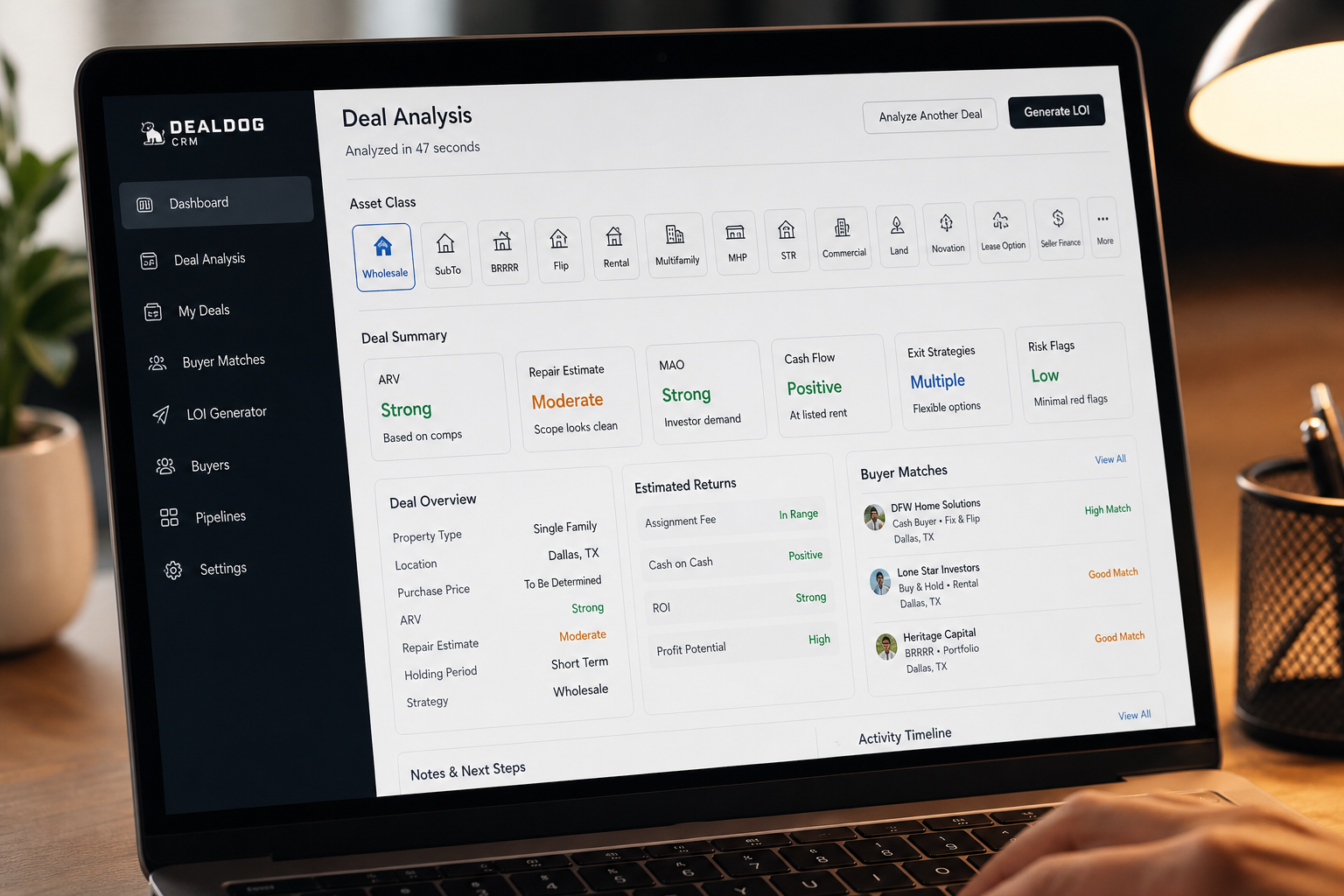
DealDog Core gives you unlimited AI deal analysis across 15 asset classes. That includes single-family wholesale, fix-and-flip, BRRRR, buy-and-hold rentals, multifamily, land, mobile home parks, storage, short-term rental, commercial, novation, SubTo, seller carry, lease option, and mixed-use. You're not locked into the SFR wholesaling lane like most tools assume you are.
Each analysis runs in roughly 60 seconds. Paste a deal description or fill out the form — you get ARV estimates, repair cost ranges, MAO, projected cash flow (for rental exits), and a plain-English risk flag summary. The kind of output that used to require either years of experience or a deal analyst you had to pay.
Core also includes in-network buyer matching. When you run a deal through the analyzer, it scans buyers in the DealDog network who've registered their buy box — property type, geography, price range, condition preference, funding type — and surfaces qualified matches automatically. You're not just running numbers in a vacuum. The deal starts moving toward a buyer the moment you analyze it.
And the LOI generator is included. Auto-generated Letter of Intent, branded, ready to send. Operators running seller finance, lease options, or novation deals know how much time a solid LOI saves — and how many deals die waiting for one.
No credit card. No 14-day clock. Just free, permanently.
Why 60-second AI underwriting changes the math for a new investor
Here's the honest version of what happens when you're new and you don't have a reliable underwriting process: you either lowball every offer out of fear (and lose deals to more confident buyers) or you overpay because you didn't model the numbers correctly and the deal looks better than it is.
Both of those outcomes are expensive. The first costs you deals. The second costs you money.
The operators I've watched scale fastest are the ones who get accurate-enough numbers quickly. Not perfect — quickly. Because in wholesale and flip, speed and accuracy together are the advantage. If you can analyze 10 leads in the time it used to take you to analyze 2, you're touching more of the pipeline with confidence instead of guessing.
Take someone like Jordan, a newer wholesaler working the Kansas City market. He was spending 45 minutes per deal trying to pull comps manually in Zillow, build a rough repair estimate from YouTube videos, and then second-guess himself anyway. He told me he'd pass on deals just because he wasn't sure — and then watch someone else move them a week later. Running those same deals through DealDog Core, he was getting structured output in under a minute and spending his actual time calling sellers and building relationships. That's the shift a free tool can make when it's actually built for the workflow.
Per the 2024 Federal Reserve Small Business Credit Survey, access to analytical and financial tools remains one of the top cited gaps for small business operators in asset-intensive industries — real estate included. The barrier isn't ambition. It's tooling.
The buyer matching piece is what separates this from a calculator

A lot of free deal calculators exist. You can find them scattered across wholesaling Facebook groups, built into Google Sheets, embedded on coach websites. What they don't do is connect your deal to a buyer.
DealDog Core does. The in-network buyer matching means that when you analyze a land deal in central Florida or a SubTo candidate in Phoenix, the system is already checking against registered buy boxes across the DealDog network. If there's a match — on geography, asset class, price range, exit strategy — you get notified. The buyer gets notified. JV referral fees are built into the workflow at the Core+ and Pro tiers, but even at Core, you're operating inside a network, not just running a solo calculator in isolation.
For a newer investor, this matters a lot. Building a real buyers list takes time. Most people starting out have maybe a handful of cash buyers they met at a local REIA meeting, and those buyers have narrow buy boxes. If your deal doesn't fit, you're stuck cold-calling through a list you bought from someone who bought it from someone else.
Cross-network matching — which opens fully at Core+ for $79/month — is where the network effect really kicks in. But even at Core, you're not starting from zero. You're inside a system where deals and buyers are already moving.
The National Association of Realtors Research & Statistics consistently shows that off-market transactions depend heavily on relationship networks for deal-to-buyer velocity. DealDog is built to replicate that network infrastructure for operators who haven't spent 10 years building one manually.
The contrarian case: free tools aren't for beginners, they're for operators who know what they're doing
There's a version of the "free tool" conversation that goes like this: free tools are for newbies who can't afford the real thing, and serious operators pay for serious software. I'd push back on that pretty hard.
The operators I know who are running 30–50 deals a year aren't paying for complexity — they're paying for speed and coverage. If a free tier gives them the analysis and the buyer matching they need for a portion of their pipeline, they use it. If the volume or the JV workflow demands Core+ or Pro, they upgrade. But the capability at Core is not a watered-down version of what a serious operator needs. It's the actual underwriting and matching layer, free.
What free tools traditionally lack is specificity. A generic deal calculator spits out a number. DealDog Core runs structured AI analysis across 15 asset classes with risk flags, exit strategy outputs, and buyer matching built in. That's not a beginner tool. That's a real workflow tool that happens to cost nothing at the base tier.
New investors benefit because they get real operator-grade output before they can afford operator-grade software. Experienced operators benefit because they're not paying $149/month for capability they only need on a subset of deals. The free tier isn't a compromise — it's the right entry point for most of the operators actually doing this work.
The DealDog Core quick-start checklist for your first 5 deals
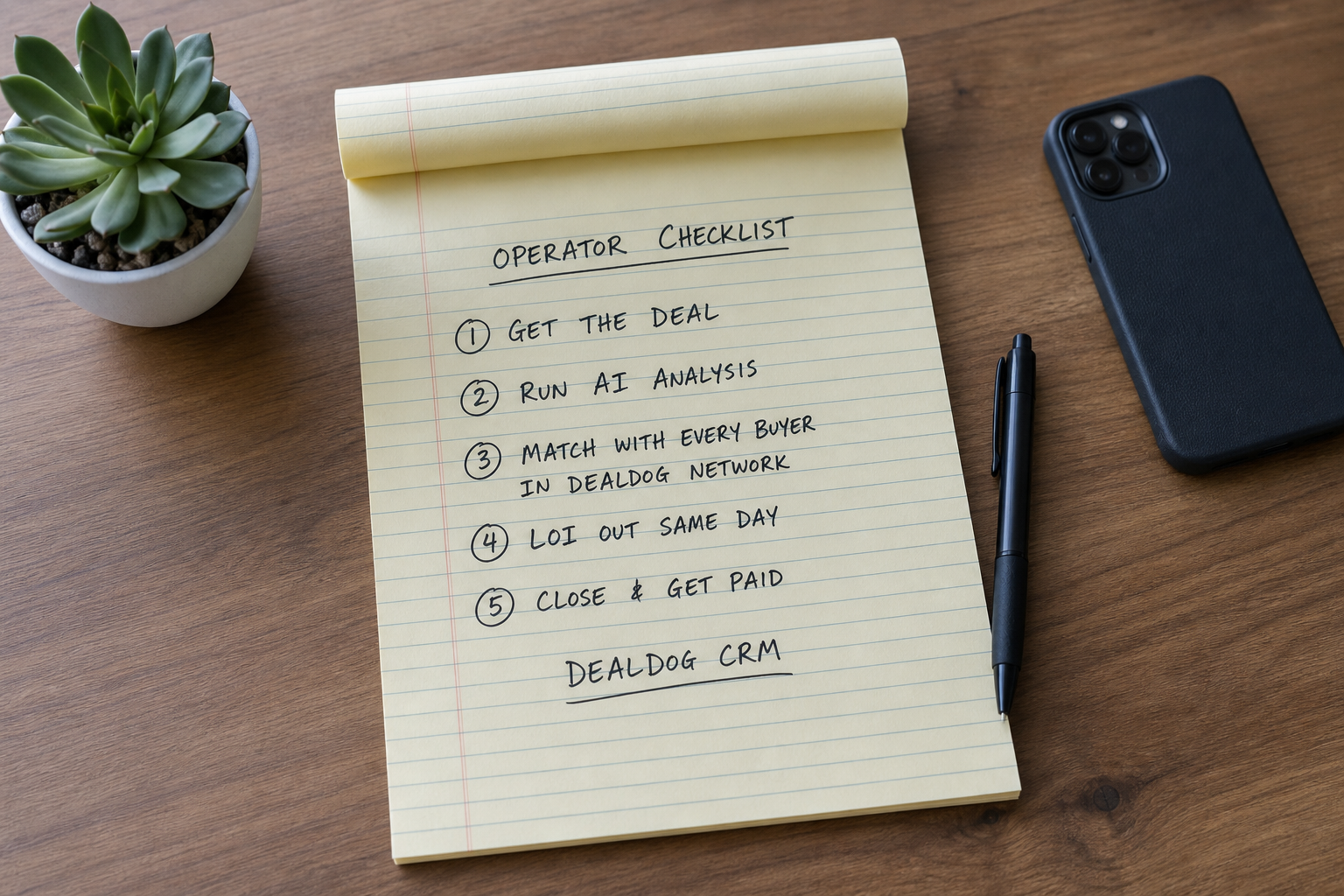
If you're just getting started with Core, here's how to actually use it instead of just having it open in a tab you forget about.
- Sign up at calculator.dealdogcrm.com/signup — takes about 2 minutes, no card required.
- Get your user code and share it with any bird dogs or wholesalers sending you deals. They submit directly into your account. You stop getting deals via text message.
- Run every lead through the analyzer before you make an offer. Even the ones that feel obvious. The risk flags alone will save you from bad deals you were about to talk yourself into.
- Register your own buy box so inbound cross-network matches can surface deals to you — not just from you.
- Use the LOI generator on your first accepted offer. Send it the same day. Sellers who get a signed LOI fast are far less likely to shop the deal to someone else while you're still drafting.
That's it. Five steps, one tool, no monthly bill. If you hit the ceiling — you're running more volume than Core handles comfortably, or you need permanent cross-network JV matching — Core+ at $79/month is the next step. But most operators doing under 20 deals a year won't hit that ceiling for a while.
Frequently Asked Questions
Is DealDog Core really free forever or is there a catch?
DealDog Core is permanently free — no trial period, no credit card required, no usage clock. You get unlimited AI deal analysis across 15 asset classes, in-network buyer matching, and LOI generation at no cost.
The paid tiers (Core+ at $79/month and Pro at $149/month) add cross-network JV matching, branded buyer communications, and a full GoHighLevel CRM subaccount respectively. Core doesn't require upgrading to stay useful.
What asset classes does the free deal analysis cover?
DealDog Core covers 15 asset classes: single-family wholesale, fix-and-flip, BRRRR, buy-and-hold rental, multifamily, land, mobile home parks, storage, short-term rental, commercial, novation, SubTo, seller carry, lease option, and mixed-use.
Most free deal calculators are built only for SFR wholesale. DealDog runs the same structured AI analysis regardless of asset class, which matters for operators working across multiple deal types.
How does the buyer matching work on the free Core tier?
When you analyze a deal in DealDog Core, the system automatically scans registered buyer buy boxes inside the DealDog network — filtered by property type, geography, price range, condition preference, and funding type — and surfaces qualified matches.
In-network matching is included free. Cross-network matching across the entire DealDog user base (with built-in JV referral fees) is a Core+ and Pro feature at $79/month and $149/month respectively.
Can bird dogs and other wholesalers submit deals to my DealDog account?
Yes. Every DealDog operator gets a user code that bird dogs, wholesalers, and buyers can use to plug into your account directly. Bird dogs submit deals, wholesalers can run the calculator or submit deals, and buyers can register their buy box to receive matched deal notifications.
This means you stop receiving deals via text and email threads. Everything comes in through one structured intake point.
How accurate is the 60-second AI underwriting?
The AI analysis is built to produce operator-grade output — ARV estimates, repair cost ranges, MAO, projected cash flow for rental exits, and plain-English risk flags — in under 60 seconds. It's not a replacement for a full appraisal or a contractor walkthrough, but it's accurate enough to make fast go/no-go decisions and to avoid the most common underwriting mistakes newer investors make.
The analysis draws on the same exit strategy logic an experienced operator applies: what does this deal look like as a flip, as a rental, as a wholesale assignment, as a seller finance play? You get that framing instantly instead of rebuilding it from scratch on each deal.
Who should start with Core versus upgrading to Core+ or Pro?
Core is the right starting point for most investors doing under 20 deals a year, anyone just getting into wholesale or flipping, and experienced operators who want to add AI underwriting without replacing their existing stack.
Core+ at $79/month makes sense when you want permanent cross-network buyer matching and unlimited LOI generation at volume. Pro at $149/month is for operators running a real business who need a full GoHighLevel CRM subaccount, branded buyer communications, pipelines, and automation — all under one roof.
